


The 3-6-9 Master Metabolic Protocol
Subtract the Noise. Restore the Signal. Rebuild the Human.
PART 1 OF 3
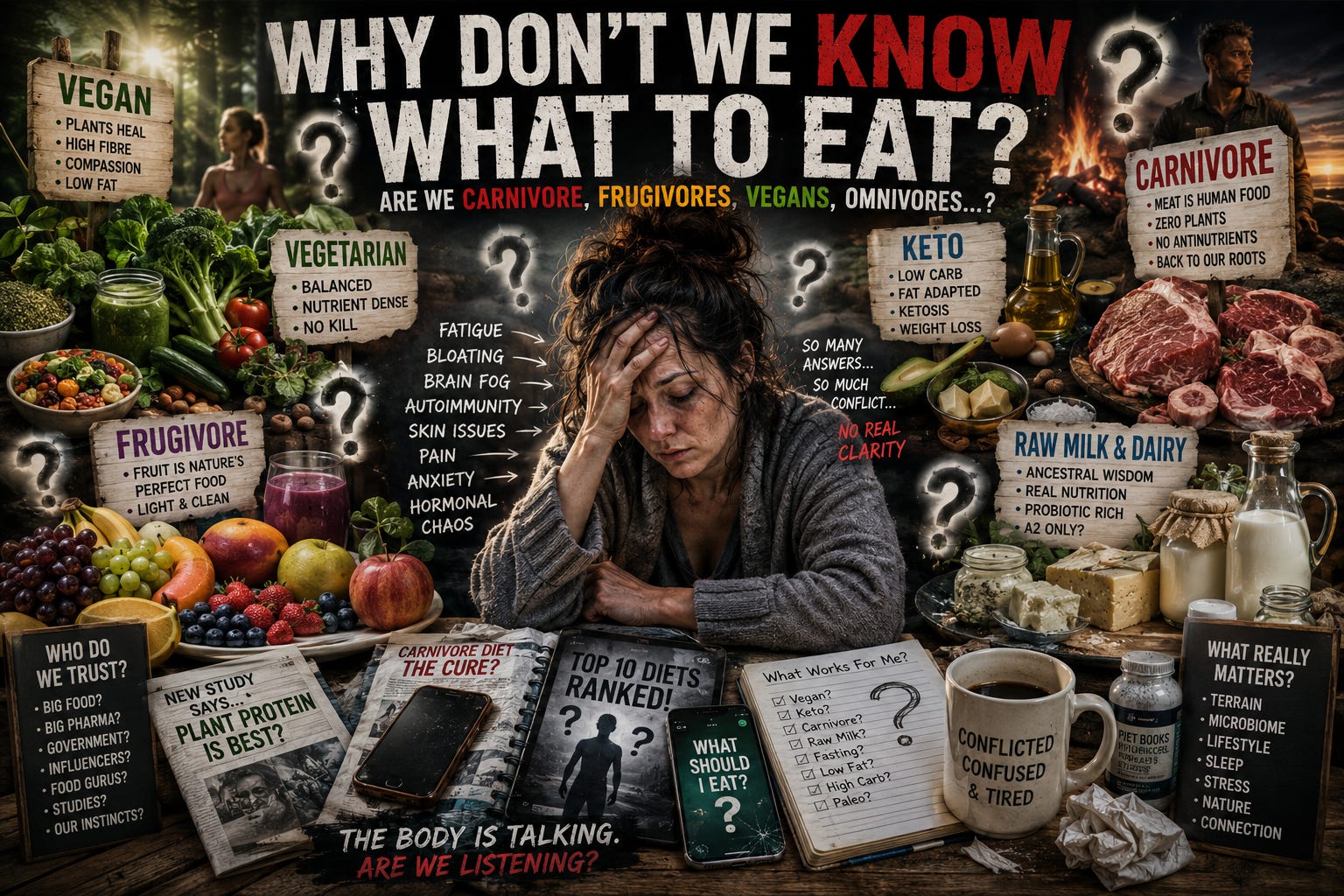
Why Don’t We Know What To Eat?
The ancestral diet was not a diet — it was survival, terrain, fire, tools, microbes, and intelligence.
Humans are often mocked as the only animal confused about what to eat.
The lion does not wonder whether it should become plant-based. The wolf does not question the morality of killing food. The cow does not count calories. The deer does not debate if it is getting enough protein. The scavenger does not worry about food poisoning or unsanitary food preparation.
And yet modern humans apparently require governments, corporations, doctors, apps, influencers, public-health campaigns, food labels, diet books, podcasts, studies, food gurus, and algorithmic arguments to explain to us what food is and what we should eat.
That should make us suspicious.
But it should also make us careful.
Probably the best current advice is, “Just eat what humans evolved to eat.”
It sounds obvious. It sounds clean. It sounds like the answer.
But it is not nearly as simple as it sounds.
Because if we take the ancestral argument literally — really literally — then the original human diet was not ribeye steak, butter, bacon, coffee, raw milk, kefir, sourdough, sauerkraut, supplements, green smoothies, olive oil, salads, protein powder, TRT, or neatly packaged organic produce.
Before farming, before herding, before milking animals, before grinding grains, before supermarkets, before refrigeration, before supplements, before vegan, frugivore, carnivore, or keto, and even before reliable fire, what did the human animal actually eat?
First, we ate (well, suckled) human milk.
That is the one universal ancestral food made specifically for human babies.
Human milk is not merely calories. It is a species-specific developmental fluid designed by God, nature, or both, to build a human baby whose gut, brain, immune system, nervous system, metabolism, and microbiome are still under construction.
And when the time came — usually as teeth began to emerge — we did not transition from breast milk to breakfast cereal.
We moved from suckling milk to mouth.
The young human began meeting the world through teeth, hands, texture, touch, smell, taste, hunger, curiosity, tribal ways, season, and terrain. Often the mother would chew first, beginning digestion before feeding the child. All the senses were involved. The child was not learning from an app, a label, or a government guideline. The child was learning through experience, sensation, observation, and the most basic biological feedback: does this nourish me, harm me, satisfy me, or make me sick?
Food was not an abstract category.
It was not a macro split.
It was not an ideology.
It was what the ancestral human could find, catch, crack, dig, gather, share, chew, swallow, and survive upon.
That may have included raw animal foods, marrow, insects, eggs, small animals, fish, shellfish, seasonal fruit, honey, roots, tubers, berries, and scavenged carcasses left behind by predators.
It would not have looked like a modern carnivore Instagram page.
It would not have looked like a vegan bowl.
It would not have looked like a Mediterranean cookbook.
It would have looked like opportunistic survival.
And that is the first problem with oversimplistic ancestral diet claims.
When someone says, “Humans should eat what we evolved to eat,” we have to ask:
Which humans?
At which stage of human history?
In which geographical terrain?
In which season?
With which tools?
With which microbes?
With which culture?
With fire, or without it?
The answer changes everything.
Before cuisine, there was survival.
A human without tools, fire, language, storage, salt, fermentation vessels, fishing nets, bows, spears, pottery, domesticated animals, and cultural memory was not eating a modern ruminant-based carnivore diet.
That human was eating whatever could be caught, cracked, dug, stolen, scavenged, chewed, sucked, swallowed, shared, or survived on.
That does not mean humans were plant-based.
It also does not mean humans were strict carnivores in the modern ideological sense.
It means humans were instinctual and ecological opportunists becoming increasingly intelligent.
But this point needs precision.
Availability is not the same as optimality.
Survival is not the same as design.
A food that keeps a starving human alive is not automatically the food that produces the highest level of health. Fallback foods, famine foods, seasonal foods, medicinal foods, staple foods, and optimal foods are not the same category.
So when I say humans were ecological opportunists, I am not saying every ancestral food was equally nourishing. I am saying humans used intelligence to survive in different terrains, and that clinical healing must still ask harder questions.
Which foods build the body?
Which foods merely spare starvation?
Which foods provoke a damaged system?
Which foods are therapeutic because they remove everything else?
Those questions should never be collapsed into one.
Our stomach acid gives us an important clue. Humans have unusually acidic stomachs, which fits a history involving animal foods, protein denaturing, scavenging, microbial exposure, and the need to neutralise potentially dangerous organisms before they passed deeper into the gut.
That matters.
It suggests humans were not fragile fruit nibblers or salad munchers afraid of animal foods.
But it also does not prove that steak-and-butter carnivore is the literal original human diet.
It points to something more interesting: a creature increasingly adapted to animal foods, microbial challenge, acidity, risk, survival, and eventually cooking.
Then fire changed everything.
Fire made meat safer, if you believe the germ theory model(which I don’t for good, factual reasons). It softened connective tissue, made marrow and fat more accessible, reduced the toxicity of certain plants, made tubers more palatable and digestible, extended the human day, and created the hearth of the gathering.
Fire changed food from something merely consumed into something transformed, shared, and social.
Tools changed the relationship even further.
A sharp stone, a spear, a fishing hook, a digging stick, a basket, a clay pot, a hide bag, a drying rack, a smoking hut, a salt pit, and a fermentation vessel were not just objects.
They were extensions of digestion.
They allowed humans to do outside the body what the body could not always do inside the gut.
Humans learned to cut, crack, pound, soak, leach, cook, smoke, dry, salt, ferment, and store.
Every one of those practices was intelligence applied to food.
Meat could be dried for winter. Fish could be smoked near rivers and coasts. Milk could be fermented into something more tolerable. Roots could be roasted until edible. Grains and seeds, where they were used, had to be soaked, ground, soured, cooked, or fermented.
Plants were not simply eaten because they existed. They were made edible through necessity, trial, error, and evolving knowledge.
Animal foods were not merely consumed as muscle meat. They were eaten nose to tail, with fat, organs, marrow, blood, broth, skin, connective tissue, and seasonal context. And every part of the animal that could not be eaten was still used for something useful.
This is why the human diet exploded into diversity.
Not because humans were confused.
Because humans were intelligent.
And starvation was not an option.
Different environments demanded different answers. Ice, desert, coast, jungle, mountain, grassland, river, forest, and island could not produce the same diet. A people surrounded by reindeer did not eat like a people surrounded by coconuts, shellfish, tubers, honey, or tropical fish.
Cuisine was not decoration.
Cuisine was survival evolving as culture.
It was memory passed through grandmothers, hunters, mothers, gatherers, healers, cooks, and tribes. It taught people which foods to eat, which foods to avoid, which foods needed fire, which needed fermentation, which needed soaking, which were medicine, which were poison, which belonged to summer, which belonged to winter, and which could save a starving village.
Cuisine was environmental intelligence.
It was the human animal learning how to turn terrain into nourishment, nourishment into social connection, and social connection into culture.
No tribe or emerging culture sat around pontificating whether they were carnivore, omnivore, frugivore, vegan, keto, or any other modern nonsense.
They simply lived within, and connected to, whatever region and environment they were born into.
This is not plant-based ideology.
It is not frugivore ideology.
It is not keto ideology.
It is not carnivore ideology.
It is ancestral survival and emerging food technology.
Humans were not stupid. They were masters of adaptation and survival with spirit.
But cuisine proves intelligence. It does not prove that every traditional food is therapeutic in every modern body.
A food can be ancestral and still be wrong for a damaged gut.
A food can be natural and still be provocative.
A food can be traditional and still require the right genetics, microbes, preparation, dose, season, and intestinal barrier.
That distinction matters.
Because healing is not nostalgia.
And it is far more than just biology.
Four questions diet culture keeps confusing
Modern diet arguments usually fail because they collapse four separate questions into one.
The first question is: what did humans eat to survive?
The answer is broad. Humans survived on different foods in different terrains. They adapted, improvised, hunted, gathered, cooked, fermented, stored, and endured.
The second question is: what foods are humans best adapted to?
That answer is narrower. The evidence points strongly towards a deep human dependence on animal-source nutrition, fat, organs, hunting, scavenging, cooking, and nutrient density. Humans are not grazing animals. We are not seed-eating birds. We are not fruit bats. We are not ruminants with fermentation vats. We are a high-energy, large-brained, acid-stomached, tool-using species with a long relationship to animal foods.
The third question is: what foods are therapeutic in serious disease?
That answer may be narrower still. In autoimmunity, inflammatory bowel disease, neurological inflammation, severe metabolic dysfunction, histamine chaos, and deep gut permeability, the most therapeutic diet may not be the most diverse ancestral diet. It may be the strictest one. It may be meat, fat, organs, salt, and water — not because all other foods are morally bad, but because the damaged body may need biological silence before it can repair.
The fourth question is: what can a restored or robust person tolerate long term?
That answer depends on the person. Some people may remain best on strict carnivore or a strict paleolithic ketogenic approach. Others may tolerate selected traditional foods once the terrain has changed. Some may use dairy. Some may not. Some may tolerate eggs. Some may relapse from them. Some may handle fermented foods beautifully. Others may experience histamine, insomnia, anxiety, migraines, skin flares, or gut pain.
These four questions must never be confused.
A food can be ancestral and still be inappropriate for disease.
A food can be tolerated and still not be therapeutic.
A food can be useful in famine and still be inferior in abundance.
A food can be traditional and still fail in the wrong terrain.
This is the foundation of the 3·6·9 Master Metabolic Protocol.
The microbiome matched the terrain
Traditional humans did not simply eat their environment. Their environment entered them.
From birth, the body was seeded by the world around it: through the birth canal, breast milk, skin contact, soil, animals, water, smoke, hands, seasonal foods, fermented foods, cooked foods, raw foods, animal fats, fibres, tribe, and outdoor life.
The microbiome was not something added later from a capsule.
It was built through contact.
It was shaped by place.
It was ecological memory living inside the body.
That is profound, because it means there was never supposed to be one universal human microbiome. A person living in a cold coastal environment, eating fish, organs, fat, marrow, shellfish, and berries, should not necessarily carry the same inner ecology as someone living in a tropical environment, eating tubers, honey, fruit, insects, and wild game.
Different terrains created different foods.
Different foods created different microbes.
Different microbes helped those people digest, adapt, and belong to the world they lived in.
The microbiome was supposed to match the terrain.
But the microbiome should not be romanticised either. The goal is not simply “more microbes,” “more diversity,” or “more fermented foods,” though all those things can help some people begin to heal.
A diverse microbial ecosystem is not automatically healthy if the gut barrier is damaged. In a damaged terrain, adding more fibres, more ferments, more probiotics, more raw foods, or more microbial stimulation can make one person better and another worse.
The first priority is not microbial entertainment.
The first priority is coherence: barrier integrity and microbial diversity learning again to co-exist.
The body must be able to distinguish nourishment from invasion. The gut lining must regain selective intelligence. The immune system must stop treating ordinary inputs as emergencies. Only then does the microbiome become a partner in rebuilding rather than another source of noise.
This is why gut health cannot be reduced to probiotics and fibre.
A healthy microbiome is not a supplement label.
It is a relationship between food, barrier, immune system, nervous system, microbes, light, sleep, soil, animals, season, and place.
Modern people have largely lost that match.
We now live under artificial light, eat sterile packaged food, drink treated water, avoid soil, fear microbes, and spray chemicals over the very environments that once educated our immune systems. We pasteurise, homogenise, refine, isolate, bleach, extract, fortify, preserve, flavour, stabilise, and standardise.
Milk becomes a processed commodity.
Fat becomes industrial oil.
Grain becomes flour.
Fruit becomes juice.
Protein becomes powder.
Sugar becomes hidden in everything.
And then we call the result nutrition.
But this is not the same thing as food.
Food carries memory.
Food carries terrain.
Food carries microbes, season, light, soil, animal health, preparation, culture, and context.
Modern feed carries shelf life, convenience, chemistry, scale, transport, palatability, profit, and control. Human biology is considered later, if at all.
That is the difference.
Traditional food connected the body to its world.
Modern feed disconnects the body from it.
Work with me
This series introduces the terrain lens behind my 3·6·9 Master Metabolic Protocol — the framework I use to help people subtract the noise, restore the signal, and rebuild the human.
For deeper teaching, live interpretation, and guided application, join my membership where I teach this and more, as well as help people heal. https://sales.jeremyayres.com/live-clinic
For more complex cases or one-to-one support, start here: JeremyAyres.com.
Work with me 1:1:Book a Consultation→https://consultations.jeremyayres.com/Initial
Coming in Part 2
In Part 2, I’ll explain how food became feed — and why the same food can heal one person and harm another depending on the terrain it enters.
The aim is not purity.
The aim is signal.
Subtract the noise. Restore the terrain. Rebuild the human.