


PART 2 OF 3
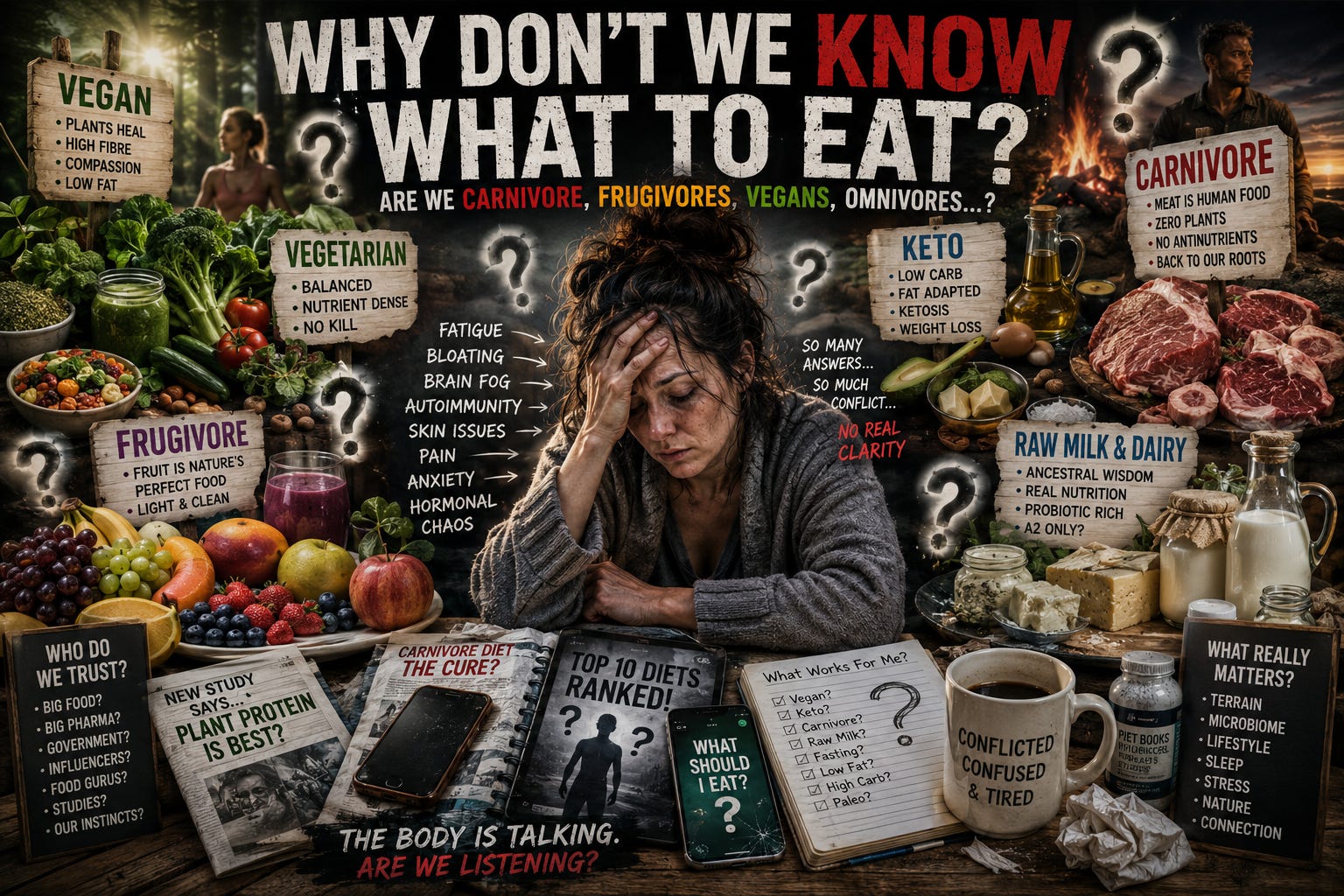
In Part 1, I argued that the ancestral diet was not one universal diet.
It was not carnivore, vegan, frugivore, keto, omnivore, raw milk, Mediterranean, or paleo as identity.
It was survival, terrain, tools, fire, microbes, season, culture, and intelligence.
Traditional humans did not merely eat food. They ate from a world. Their microbiomes matched their environment. Their cuisines matched their climate. Their bodies matched their light. Their communities gave food meaning.
Modern people have largely lost that match.
And once that match was lost, food gradually became something else.
It became feed.
When food became feed
The great dietary catastrophe was not simply that humans ate plants.
It was not simply that humans stopped eating meat.
It was that food was removed from ecology and converted into production.
Slow food became fast feed. Local became global. Seasonal became permanent. Fermented became sterile. Whole became fractionated. Animal became feedlot. Milk became pooled, pasteurised, homogenised, transported, fortified, and standardised. Fat became extracted oil. Grain became flour. Corn became syrup. Soy became isolate. Fruit became juice. Milk became formula. Food became a shelf-stable product.
This matters because much of what modern people call plant-based is not ancestral plant food.
Even where the name is familiar — apple, tomato, carrot, wheat, lettuce, banana, potato — the modern commercial version is often not the same biological event our ancestors would have known. Over time, plants have been selected, hybridised, standardised, sweetened, enlarged, made more uniform, bred for shelf life, bred for transport, bred for appearance, chemically protected, stored out of season, shipped across continents, and marketed for commercial yield rather than human terrain.
That does not mean every modern fruit or vegetable is automatically poisonous. It means we should stop pretending that supermarket produce, year-round fruit, sprayed salad leaves, seedless varieties, commercial grains, hydroponic greens, protein isolates, and fake-meat products are the same thing as wild, local, seasonal, traditionally prepared plant foods eaten by a people whose microbiome, climate, light exposure, and food culture matched their environment.
And much of what is now sold as “plant-based” is not recognisable plant food at all. It is industrial plant material: flours, syrups, isolates, seed oils, fortified cereals, fake meats, powders, gums, emulsifiers, stabilisers, sweeteners, flavourings, colourings, and ultra-processed substitutes dressed up as health.
Much of what modern people call dairy is not ancestral milk.
It is pooled, pasteurised, homogenised, standardised commodity milk, stripped from the individual animal, the herd, the season, the pasture, the farm, the microbial culture, and the traditional methods that once made milk more biologically intelligible. Farm milk from a known animal, fermented milk from a traditional culture, raw milk consumed in a pastoral context, aged cheese, kefir, yoghurt, butter, ghee, and pooled industrial milk are not the same biological message.
Much of what modern people call meat is not ancestral animal food either.
It is not wild, hunted, trapped, fished, pastured, or nose-to-tail nourishment eaten with fat, organs, marrow, bones, skin, broth, blood, and seasonal context. It is often grain-fed, confined, processed, preserved, packaged muscle meat, separated from the animal, the land, the hunt, the herd, the fisherman, the farmer, the season, and the ecology that produced it.
So the real problem is not simply plants, dairy, or meat.
The problem is that the category names have survived while the biological meaning has been altered.
“Plant-based” can mean a cooked tuber eaten in season by an outdoor people with a matching microbiome, or it can mean seed oils, oat milk, fake burgers, fortified cereal, and industrial sludge.
“Dairy” can mean human milk, raw farm milk, fermented goat kefir, aged cheese, or pooled, pasteurised, homogenised commodity milk from thousands of animals.
“Meat” can mean wild game, ruminant fat, organs, marrow, fish, shellfish, blood, broth, and whole-animal nutrition, or it can mean processed, preserved, feedlot muscle meat eaten under artificial light by a stressed, sedentary, metabolically damaged modern human.
The body does not respond to labels.
It responds to biological events and signals.
And the biological event is shaped by source, season, preparation, terrain, timing, microbial capacity, nervous-system state, and the life of the person eating it.
We are arguing over diet labels while consuming substances whose source, structure, preparation, and biological message our ancestors would scarcely recognise.
Industrialisation was not just food
The collapse of the human terrain did not come from diet alone.
Food changed.
But so did everything else.
We moved indoors and lost sunlight. We replaced darkness with artificial light and seasonal rhythm with clock time. We replaced local community with displacement, cities, commuting, screens, wars, famine, economic fear, and chronic stress. We replaced soil contact with chemical hygiene. We replaced birth ecology with increasingly medicalised birth. We replaced breast milk with formula in many cases. We replaced traditional medicine with pharmaceuticals for every discomfort. We replaced infection resilience with sterile fragility. We replaced purpose with productivity.
This is not an argument against emergency intervention when it is truly needed. Modern tools can save lives. A C-section can save a mother or baby. Antibiotics can save a life. Formula can keep an infant alive when no human or mammalian milk is available. Pharmaceuticals can sometimes hold a collapsing system together.
The problem begins when tools designed for emergency rescue become the default ecology of everyday life, and when the long-term biological costs of living inside that artificial ecology are ignored. Rescue is not the same as design. Survival is not the same as health. A substitute that saves life in crisis should not automatically become the model for how life is meant to be lived.
Artificial light at night, sleep disruption, environmental chemicals, pharmaceutical load, indoor living, chronic fear, trauma, displacement, and relentless stress all belong in the terrain history.
Stress is not a metaphor.
Chronic stress changes digestion, secretion, motility, inflammation, gut permeability, immune regulation, blood sugar, sleep architecture, and microbiome patterns.
A body under threat does not break down food, absorb nutrients, repair tissue, regulate immunity, or rebuild microbial balance in the same way as a body that feels safe.
This is why a dietary protocol sometimes has to become extreme.
Not because the human being was designed to live forever on what may appear to be a narrow and restrictive emergency diet.
But because the modern terrain is often so overloaded that the first step in healing is radical subtraction.
What I mean by terrain
The word terrain can become vague if it is not defined.
So here is my understanding:
Terrain is the biological context a body has inherited, accumulated, and currently lives within.
It is where the body has come from, what has happened to it, and the condition into which every food, ‘medicine’, stressor, signal, and intervention enters.
It includes gut barrier integrity, metabolic state, immune activation, microbial history, birth history, early feeding, medication exposure, toxicant load, light environment, sleep rhythm, nervous-system state, stress physiology, trauma, dental and infection burden, and the person’s current capacity to digest, absorb, detoxify, repair, and regulate inflammation.
Terrain is why the same food is not the same event in two different people.
A food does not enter an abstract human body.
It enters a terrain created by a history — positive, negative, or both.
It enters a gut lining shaped by birth, feeding, antibiotics, vaccinations, infections, stress, sleep, light, medications, trauma, and years of food or feed exposure. It enters an immune system that may be calm or hypervigilant. It enters a nervous system that may feel safe or threatened. It enters a liver already processing chemicals, alcohol, drugs, mould toxins, hormones, and inflammatory signals. It enters a microbiome that may match the person’s world, or may be profoundly mismatched to it.
This is why diet debates become simplistic.
They argue over foods while ignoring the body those foods enter, and the environment they occupy.
One person drinks raw kefir and feels alive.
Another drinks the same kefir and wakes with sinus congestion, itching, panic, insomnia, migraine, eczema, diarrhoea, or joint pain.
One person eats eggs and thrives.
Another eats eggs and flares.
One person uses fermented vegetables as a bridge back to microbial life.
Another is thrown into histamine hell.
That is not contradiction.
That is terrain.
And this begins to explain why people have reported healing on almost every diet ever named: vegan, vegetarian, keto, carnivore, fasting, paleo, low-FODMAP, fruit-based, raw food, GAPS, Mediterranean, and more.
It is not because every diet is equally true.
It is because every diet changes the terrain.
Each one removes something, adds something, starves something, feeds something, calms something, or provokes something.
A vegan may heal because they removed processed food, dairy, alcohol, and industrial meat.
A carnivore may heal because they removed grains, seed oils, sugar, fibre, lectins, oxalates, ferments, and plant irritants, while finally giving the body dense, bioavailable animal nutrition.
A person fasting may improve because food input stops altogether. Digestion is allowed to rest. The body is no longer forced to process, interpret, defend, ferment, react, or detoxify the next meal. The incoming burden pauses, and the body may redirect energy toward cleansing, repair, and restoring order.
A vegetarian may improve because they stopped living on takeaways, alcohol, processed meats, fried foods, and supermarket feed, and began cooking real meals again. The improvement may come from subtraction, simplicity, rhythm, and attention — not from the absence of meat. And if vegetarianism becomes grains, pulses, seed oils, pasteurised dairy, fake meats, sugar, and moral ideology, it can become just another beautifully branded form of biological confusion.
The diet gets the credit.
But in my experience, the real healing response is usually explained by two things: what burden was removed, and how the terrain responded once that burden was gone.
Enter Dr Zsófia Clemens and Paleo Medicina
This is where Dr Zsófia Clemens’ work becomes important.
Not because it answers everything.
Because it shows what can happen when almost everything is removed.
I lectured some years ago alongside Dr Clemens at a carnivore conference in Spain. I have a great deal of respect for her and her husband’s work, even where I think the wider terrain must also be considered.
Dr Clemens and the Paleo Medicina group in Hungary have spent years working clinically with difficult diseases, including diabetes, autoimmune conditions, cancer, neurological disorders, and medically complex disease states, using what they call the Paleolithic Ketogenic Diet.
This is not generic internet carnivore.
It is a strict, medically applied animal-based ketogenic diet centred on meat, animal fat, and organs, with careful attention to fat-to-protein balance, food exclusion, and clinical monitoring in serious disease.
In a medical world that often manages symptoms while ignoring diet, permeability, food antigens, and metabolic terrain, Paleo Medicina has had the courage to do something radical:
Remove the biological noise and measure what happens.
That is no small thing.
Dr Clemens’ central claim is that autoimmune disease is deeply linked to intestinal permeability — the loss of selective barrier function in the gut.
In the interview I reviewed after some of my members asked me to look at it, she argues that in serious disease, foods outside meat, animal fat, and organs can disturb the intestinal barrier. She specifically identifies cereals and milk or dairy as major problems, and names psoriasis, type 1 diabetes development, and Crohn’s disease as especially sensitive to milk proteins.
That frequently makes the carnivore world uncomfortable.
Because many carnivore diets are not truly carnivore diets.
They are meat-plus-dairy diets.
Steak and butter.
Beef and cream sauces.
Burgers and cheese.
Raw milk and honey.
Kefir and eggs.
Even the sacred egg.
But Dr Clemens’ point is simple.
Milk is not meat.
Milk is a mammalian growth fluid.
Milk is for infants.
Human milk is for human infants.
Cow milk is for calves.
And if you think about it, most people (except possibly deviants) would not consume human breast milk if it were bottled and sold instead of cow’s milk. Most would find the thought naturally abhorrent. Just imagining a latte made with breast milk is probably enough to bankrupt Starbucks overnight.
That does not mean every adult must avoid every form of dairy forever. Humans have had a long history drinking and consuming mammalian dairy.
But it does mean dairy should not be smuggled into carnivore as if it were liquid beef.
This is where Dr Clemens’ work is most valuable.
It reminds us that clinical subtraction must be honest.
If the therapeutic claim is “meat, fat, organs, salt, and water,” then butter, cream, yoghurt, kefir, cheese, eggs, coffee, sweeteners, spices, processed meats, and supplements do not belong inside that experiment.
A strict protocol has to be strict enough to teach us something.
Otherwise, when the person fails, we do not know whether carnivore failed, dairy failed, eggs failed, histamine failed, coffee failed, additives failed, or the person never actually removed the noise.
Raw milk is not one question
The raw milk debate is usually framed badly.
It becomes either:
Raw milk is poison.
Or:
Raw milk is medicine.
Both are too simple.
The better question is:
Whose milk, from what animal, raised how, processed how, consumed by whom, in what terrain, and at what stage of healing?
Human colostrum is not the same as human milk.
Human milk is not the same as formula.
Cow milk is not the same as goat or sheep milk.
A1 milk is not the same as A2 milk.
Raw farm milk is not the same as pooled industrial milk.
Pasteurised milk is not the same as homogenised milk.
Kefir is not the same as yoghurt.
Aged cheese is not the same as fresh milk.
Butter is not the same as ghee.
Colostrum is not the same as ordinary dairy.
These are not interchangeable substances.
And the person receiving them is not interchangeable either.
Questions need to be asked.
Were they breastfed?
Did they receive colostrum?
Were they born vaginally or by C-section?
Was the cord clamped immediately?
Were they given antibiotics early?
Were they formula-fed?
Were they vaccinated?
Did they have eczema, colic, reflux, asthma, ear infections, hay fever, tonsillitis, allergies, or migraines? Frequently found in the vaccinated and usually absent in unvaccinated children.
Were they raised on industrial milk, cereal, seed oils, sugar, and processed food?
Are they now living in trauma, grief, fear, mould exposure, chemical exposure, sympathetic dominance, or chronic fight-or-flight?
Do they live and work predominantly inside, under artificial light and surrounded by EMF fields, disconnected from sunlight, soil, movement, and seasonal rhythm?
These questions matter because context changes the signal. The same food enters a different body when that body is under threat, chemically burdened, light-disrupted, microbially depleted, or cut off from the rhythms that make digestion safe. Context changes the stress load, and the stress load changes the biology.
Raw milk may belong late in the discussion, not early.
It should not be used as a foundational healing food in a damaged gut simply because it is raw, traditional, or nutrient-dense.
Milk is a growth fluid. It contains proteins, sugars, immune signals, hormones, and microbial variables that make it biologically different from meat.
In a robust person, from a clean source, with the right microbial history and genetic context, it may be tolerated and even beneficial.
In a permeable, autoimmune, histamine-reactive, neurologically inflamed, or metabolically unstable person, it can be too much, too soon, or wrong altogether.
Raw does not automatically mean ancestral.
Raw milk from a modern dairy system, even a small farm, is still not the same thing as species-specific human milk. It is not the same thing as milk consumed by a calf. It is not the same thing as fermented milk consumed by a genetically and microbially adapted pastoralist population. And it is certainly not the same thing as meat.
A teaspoon of raw kefir may be tolerated by one person.
In another, it may mean histamine, immune provocation, sinus congestion, itching, panic, insomnia, migraine, eczema, or relapse.
That is not contradiction.
That is terrain.
The lost first foods
The modern conversation about milk is upside down.
We argue about raw cow milk while ignoring the fact that many humans missed human milk.
We argue about kefir while ignoring colostrum.
We argue about A2 milk while ignoring formula.
We argue about pasteurisation while ignoring birth.
C-section rates, early cord clamping, missing colostrum, formula feeding, antibiotic exposure, vaccination and reaction history, pharmaceutical use, fever suppression, immune challenges, early-life medical interventions, and the timing of all of these relative to the child’s overall terrain all belong in the terrain history.
This is not about blame.
Formula may be necessary in current modern life, when access to mammalian milk or a wet nurse is not possible.
Formula can save lives.
No parent should be shamed for using it when needed.
But biologically, formula is not human milk.
In fact, it is not milk at all.
The first food is supposed to be biological instruction.
Colostrum and breast milk are immune education, microbial seeding, hormonal messaging, oligosaccharide feeding, specifically to grow a robust microbiome, maternal signalling, and species-specific development. They are not static products. They are dynamic communication between mother and infant.
In fact, the biofeedback between the baby and nursing mother can alter the milk quality and components quite dramatically.
Formula can never replicate that.
So when I see an adult who was C-sectioned, formula-fed, antibiotic-exposed, vaccinated, industrial-milk-fed, cereal-fed, medicated early, raised under artificial light, pushed through stress, and traumatised — and that person now reacts badly to dairy — I do not see a mystery.
I see a terrain history.
Milk did not enter a blank body.
It entered a body with a story.
Why subtraction sometimes has to become extreme
This is where the 3·6·9 Master Metabolic Protocol that I have written begins.
When the terrain is overloaded, the first healing move is not addition.
It is subtraction.
Not more supplements.
Not more medications.
Not more superfoods.
Not more powders.
Not more green juice.
First, we begin to remove the noise.
The sicker the terrain, the more extreme the subtraction may need to be.
This is what Dr Clemens’ work shows so clearly.
A person with severe autoimmunity, Crohn’s, psoriasis, neurological inflammation, metabolic disease, cancer terrain, histamine chaos, or deep gut permeability may not be ready for raw milk, kefir, eggs, sauerkraut, fruit, honey, herbs, or ancestral plants.
They may need the cleanest biological silence they have ever experienced:
Fresh ruminant meat.
Animal fat.
Salt.
Water.
Measured organs, where tolerated.
Not necessarily forever.
But long enough to hear the body again.
This is why I am not critical of Dr Clemens’ subtraction method.
I think it is one of the most important modern clinical demonstrations of what happens when the input is radically simplified.
But no protocol should become a closed theology.
If a patient genuinely follows a strict protocol and the tests do not come back positively, or they fail to heal, the answer cannot always be:
“You cheated.”
Sometimes they may have. That is human nature in my experience.
But some did not.
Perhaps many did not.
We are working with complex Human BEINGS, not lab-rat Human Doings.
Sometimes the diet and protocol remove one layer, and the changed terrain reveals another layer — and frequently layers.
Trauma, which can lead to self-sabotage loops.
Sympathetic dominance.
Mould.
Chemical exposure.
Artificial light.
Medication effects.
Dental infection.
Birth history.
Formula history.
Vaccination damage.
Pharmaceutical load.
Sleep disruption.
Fear.
Grief.
Loss of purpose.
A body in fight-or-flight does not digest the same way.
A body in terror does not repair the same way.
A body that does not feel safe does not receive nourishment the same way.
This is why subtraction must go beyond food, and why we must better understand the dis-ease.
Work with me
This is the kind of terrain history we work through inside the 3·6·9 Master Metabolic Protocol / Live Clinic — not as a diet religion, but as a method for understanding why the body lost tolerance, what needs to be removed first, and what must be stabilised before anything is added back.
Join the 3·6·9 Master Metabolic Protocol / Live Clinic Membership.
For more complex cases or one-to-one support, start here: https://consultations.jeremyayres.com/Initial
JeremyAyres.com
Coming in Part 3
In Part 3, I’ll address one of the most viral claims in modern carnivore — “plants are trying to kill you” — and explain where Dr Anthony Chaffee may be right, where I believe the argument goes too far, and why carnivore, PKD, fasting, vegan, vegetarian, and even fruitarian diets can all appear to heal.
The deeper answer is not diet identity.
It is subtraction, stabilisation, rebuilding — and the terrain that receives the food.